


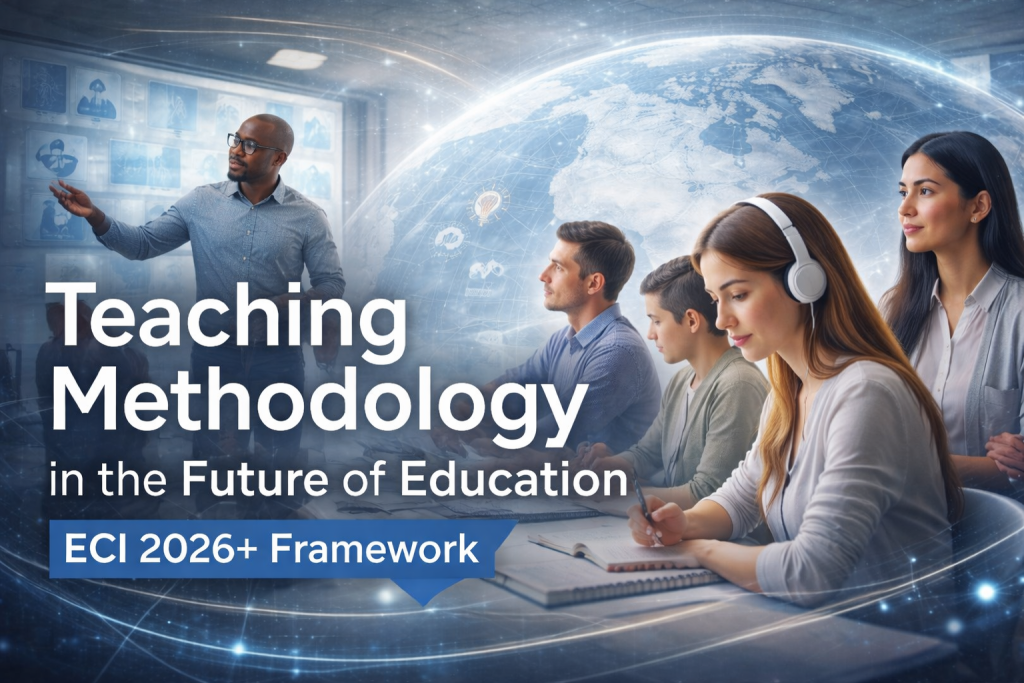
Introduction: Why Teaching Methodology Is Being Questioned Today
For decades, teaching methodology was treated as a classroom-level concern—how a teacher delivers content, manages students, or evaluates learning. Lecture methods, discussion methods, project work, and demonstrations formed the backbone of teacher training across the world.
However, something has changed.
Learners today live in a world defined by rapid technological shifts, information overload, global uncertainty, and evolving social realities. In this context, a critical question has emerged:
Are traditional teaching methodologies still preparing learners for the world they will inherit?
Education Charter International (ECI) 2026+ approaches this question not as a classroom problem, but as a system-level challenge—one that requires rethinking teaching methodology beyond techniques and toward purpose, context, and responsibility.
What Teaching Methodology Traditionally Meant
Historically, teaching methodology focused on how instruction was delivered. Common classifications included:
- Teacher-centred vs learner-centred approaches
- Lecture, demonstration, discussion, and project methods
- Textbook-driven syllabi and standardised assessment
These methodologies evolved during a time when:
- Knowledge was scarce
- Information moved slowly
- Career paths were relatively stable
- Education systems prioritised uniformity
In such conditions, structured and standardised teaching methods made sense.
But those conditions no longer exist.
Why Traditional Teaching Methodology Is Struggling Today
Despite the dedication of teachers worldwide, many traditional methodologies are under pressure due to forces far beyond the classroom.
1. Information Is No Longer the Scarcity
Students now access information instantly. Teaching methods built solely around content delivery risk becoming irrelevant unless they add interpretation, context, and critical thinking.
2. The Nature of Work Is Changing
Automation, artificial intelligence, and globalised economies demand adaptability, problem-solving, and ethical judgment—skills that cannot be developed through rote instruction alone.
3. Learner Well-Being Is Under Strain
Academic pressure, digital distraction, and mental health challenges require methodologies that are humane, supportive, and emotionally intelligent.
4. One-Size-Fits-All Models No Longer Work
Classrooms today are diverse—culturally, cognitively, and socio-economically. Uniform teaching methods often fail to address varied learning needs.
These realities expose a deeper issue: teaching methodology cannot remain isolated from the broader purpose of education.
Teaching Methodology Through the Lens of ECI 2026+
Education Charter International (ECI) 2026+ reframes teaching methodology as part of a global education framework, not merely a pedagogical choice.
Under ECI 2026+, teaching methodology is understood as:
The structured way in which learning environments are designed to help learners think, adapt, collaborate, and act responsibly in an uncertain world.
This shift moves teaching methodology:
- From instruction to learning design
- From authority to facilitation
- From uniformity to context-aware practice
Key Shifts in Teaching Methodology by 2026+
1. From Content Delivery to Learning Design
Teachers are no longer expected to be information transmitters. Instead, they become designers of meaningful learning experiences that encourage inquiry, reflection, and application.
2. From Examination Focus to Competency Development
Assessment-driven teaching methodologies are giving way to approaches that value skills, understanding, and long-term capability over short-term memorisation.
3. From Isolated Classrooms to Connected Learning Ecosystems
Learning increasingly happens across physical classrooms, digital platforms, communities, and real-world contexts. Teaching methodology must reflect this expanded ecosystem.
4. From Control to Trust and Mentorship
Future-ready methodologies emphasise guidance, feedback, and mentorship—recognising learners as active participants rather than passive recipients.
5. From Technology Use to Ethical Technology Integration
ECI 2026+ does not promote technology for its own sake. Teaching methodologies must integrate digital tools thoughtfully, ensuring they enhance human judgment rather than replace it.
What This Means for Teachers
Under the ECI 2026+ framework, teachers remain central—but their role evolves.
Teachers become:
- Facilitators of thinking
- Mentors rather than mere instructors
- Ethical guides in a complex information landscape
This shift requires support through professional development, institutional trust, and policy alignment—not increased pressure.
What This Means for Schools and Institutions
Schools must rethink teaching methodology as part of their educational culture, not just lesson plans.
Future-ready institutions focus on:
- Flexible learning environments
- Interdisciplinary approaches
- Teacher autonomy paired with accountability
- Learner well-being alongside achievement
Teaching methodology becomes a reflection of institutional values.
What This Means for Policymakers
ECI 2026+ emphasises that teaching methodology cannot evolve in isolation from governance.
Policymakers must:
- Encourage innovation without imposing uniform mandates
- Support evidence-based practices
- Align curriculum, assessment, and teacher training with long-term educational goals
Teaching methodology reform succeeds only when policy enables it.
Conclusion: Teaching Methodology as a Shared Responsibility
Teaching methodology is no longer just about how lessons are taught. It is about how societies choose to prepare their next generation.
Education Charter International (ECI) 2026+ does not prescribe a single method. Instead, it offers a framework—one that recognises diversity, uncertainty, and responsibility as defining features of future education.
As education systems look beyond 2026, the question is not whether teaching methodology will change—but whether it will change thoughtfully.
The future of education depends on that choice.
📌 About Education Charter International (ECI) 2026+
Education Charter International (ECI) 2026+ is a global education framework exploring how learning systems must evolve to remain relevant, equitable, and future-ready in a rapidly changing world.